The archive / File 001
They Escaped the CBDC: The Fatal Cost of Free Money
Declassified October 9, 2026 · 14 min
In November 2038, the Federal Reserve deleted physical cash forever. In its place came the CBDC: programmable money with expiration dates, biometric locks, and total behavioral control. When four thousand citizens retreated into the mountains to protect their freedom, they believed they were building a sanctuary. They had no idea they were building a slaughterhouse.
Within thirty-six months, the town of Oakhaven rediscovered barter, triggered a catastrophic bank run, and replaced digital surveillance with something far more brutal: debt collateral paid in human blood. This is the chronicle of what happens when cash dies, and why escaping the financial grid cost them everything.
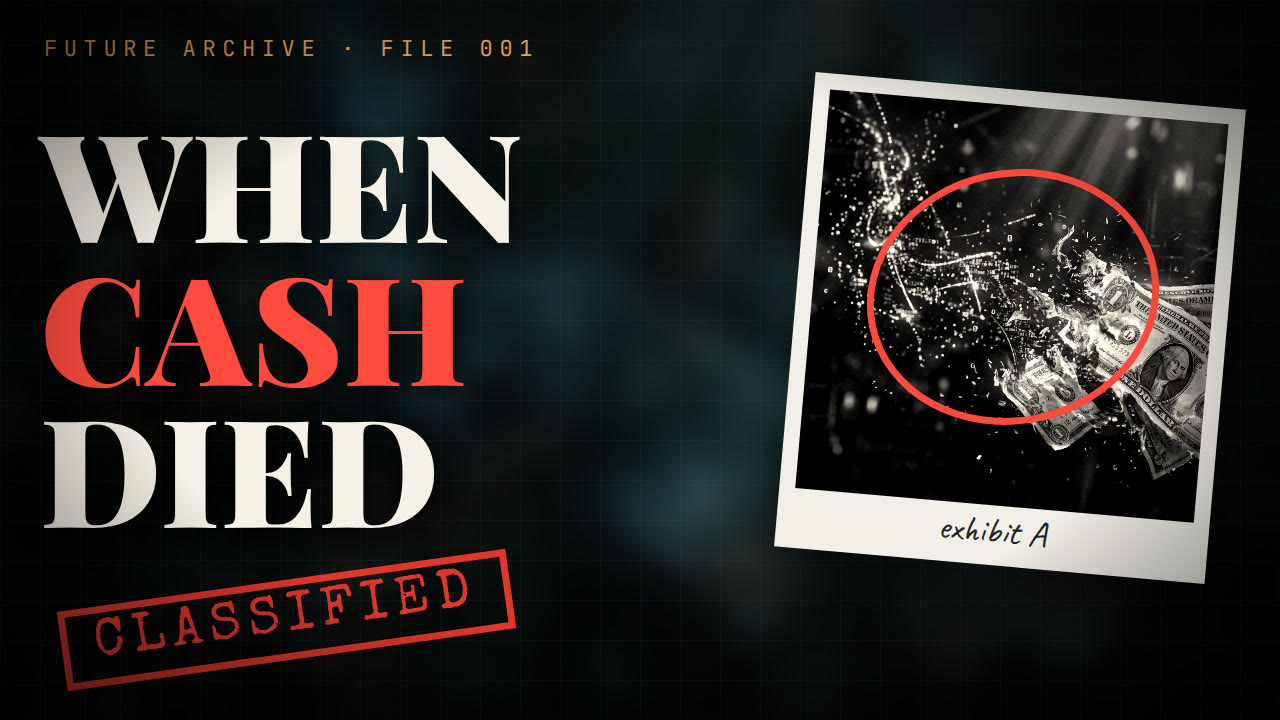
Evidence
The full account
Cashless utopia
It was supposed to be the end of poverty. In November of 2038, the Federal Reserve pressed a button, and the last physical dollar was permanently deleted from the global ledger. Cash was dead. It was replaced by a sterile, perfect system. A digital coin for every citizen, tracked, traced, and optimized. There would be no more bank runs. No more black markets. No more inflation.
It was the greatest economic triumph in human history. But deep in the mountains of the Pacific Northwest, a town of four thousand people refused to upgrade. Oakhaven. They severed their fiber-optic lines. They burned their digital wallets. They thought they were preserving human freedom. They thought they were building a sanctuary against tyranny. They had no idea they were building a slaughterhouse.
This is the story of how the last free people on earth dug their own graves, not with chains, but with pieces of paper. And they did it smiling.
To understand why Oakhaven ran, you have to understand what they were running from. By the early 2030s, the economy was bleeding out. Inflation was a fire that could not be put out. The central banks tried everything. Interest rates were manipulated, money was printed, but the velocity of currency was broken. The solution was elegant. The Central Bank Digital Currency. It was not a cryptocurrency.
There was no decentralized freedom here. It was programmable money.
Every citizen was issued a direct account with the central bank. No middlemen. No retail banks. At first, it felt like a miracle. Stimulus checks arrived instantly. But then came the conditions.
The money was smart. If the economy was slowing down, the central bank programmed your money to lose value by two percent every week. You had to spend it, or you would lose it. If inflation was too high, your digital wallet simply locked your savings for thirty days. You could not buy a plane ticket if your carbon footprint was too high for the month.
You could not buy red meat if your health premiums were in arrears. It was frictionless control. The invisible hand of the market was replaced by the algorithmic fist of the state.
Most people surrendered without a fight. The convenience was intoxicating. Crime plummeted to zero overnight. You cannot rob a store when every cent is registered to a biometric heartbeat. The streets were safe. The markets were stable. The cage was gilded.
But Elias Thorne did not want a cage. Elias was a historian, a man who ran the Oakhaven hardware store and read old books by candlelight. He understood that whoever controls the money controls the morality of a nation.
On a cold Tuesday in November, Elias stood in front of the Oakhaven town hall. He proposed a radical idea. Secession. Not political secession, but economic. If they did not use the digital grid, the grid could not control them. The town voted. Four thousand people chose the dark. They smashed their biometric scanners. They pooled their physical supplies. They closed the roads.
The barter trap
For the first few months, Oakhaven felt like paradise. They reverted to the oldest economic system in human history. Barter.
Elias traded nails for eggs. Sarah, the town doctor, traded medical checkups for firewood. It was intimate. It was deeply human. The air felt cleaner. The community grew tighter. They looked at the glowing red lights of the digital cities on the horizon and pitied the slaves down below.
But barter has a fatal flaw. Economists call it the double coincidence of wants.
Winter came early that year. Elias needed firewood, but the lumberjack did not need nails. The lumberjack needed a winter coat. The tailor who made coats did not need wood, he needed antibiotics. Trade froze. The economy of Oakhaven ground to a halt. People were sitting on wealth they could not exchange. The town was starving, not from a lack of resources, but from a lack of liquidity.
They needed money. They needed a medium of exchange.
Physical cash was useless. The paper dollars they had hoarded had no purchasing power outside the town, and inside, they were just reminders of the government they had fled. They needed something with intrinsic value. Something scarce.
Copper standard
Elias and the town council devised a solution. The Oakhaven Copper Standard.
They stripped the wiring from the abandoned data center on the edge of town. They melted it down. They stamped small copper coins. Each coin represented one hour of skilled labor. They called them Hours.
It was a beautifully analog system. There were no algorithms. No negative interest rates. No central bank freezing your account because you said the wrong thing. An Hour was an Hour. If you held it in your hand, it was yours.
Trade exploded. The lumberjack bought his coat with Hours. The tailor bought antibiotics. The doctor bought nails. The economy roared back to life. Oakhaven became a bustling hub of unregulated, pure free-market capitalism. It was beautiful. Simply beautiful.
They had beaten the system. They had proven that human beings do not need a digital overlord to organize society.
But they had forgotten a fundamental rule of economics. Money is a technology. And like all technology, it can be hacked.
By year three, the cracks began to show. The problem was not the digital world outside. The problem was human nature inside.
A man named David Miller realized something about the copper Hours. They were heavy. They were hard to store safely. And more importantly, there was a finite amount of copper in the town.
Miller started offering a service. A secure vault in his reinforced basement. You could deposit your copper Hours with him, and he would write you a paper receipt. A promissory note.
People trusted Miller. He was a good man. Soon, people stopped trading the heavy copper coins. They just traded Miller’s paper receipts. It was easier.
Elias watched this happen and felt a cold knot in his stomach. He recognized what Miller had accidentally invented. A rudimentary retail bank.
Then, Miller made the leap that destroys empires. He noticed that the townspeople rarely came to withdraw their actual copper all at once. The copper just sat in his vault. So, when a local farmer needed a loan to buy seed, Miller did not lend him the copper. He just wrote out a new paper receipt.
Miller created money out of thin air. He reinvented fractional reserve banking in a town that had isolated itself to escape it.
For a short time, it felt like an economic boom. There was more paper money circulating. People felt richer. But the copper backing those notes had not increased.
Paper collapse
Inflation hit Oakhaven not as an algorithm, but as a physical force. The price of bread went from one paper Hour to five. Then to twenty. The townspeople realized their paper receipts were losing value every day. Panic set in. A classic bank run occurred.
Three hundred people stormed Miller’s house, demanding their copper. But the copper was not there. Miller had issued ten times more paper than he had metal.
The mob did not wait for a trial. There were no police. There was no state. They dragged Miller into the street and beat him to death with the very copper coins they found in his vault.
The Oakhaven economy collapsed overnight. Trust was gone. The copper was hoarded by the violent. The paper was worthless.
They were back to square one, but worse. Now there was blood on the ground.
The town council met in emergency session. People were desperate. Some wanted to turn the digital grid back on, to beg the central government for forgiveness. But they couldn't. Their digital identities had been purged. To the outside world, they no longer existed. They were trapped in the dark.
Blood collateral
They needed a new currency. But this time, nobody trusted copper. Nobody trusted paper. Nobody trusted banks. They needed a currency that could not be faked, could not be hoarded, and carried absolute, terrifying consequences.
It was Elias who proposed it. His voice trembled in the freezing town hall.
He said money is just a ledger of debts. A record of who owes what to whom. The problem was not the medium. The problem was the collateral. If you default on a digital coin, the state freezes your account. But in Oakhaven, there was no state. The collateral had to be physical. It had to be personal.
They invented the Debt Bind.
It was a piece of parchment. On it, you wrote the exact value of goods you were borrowing. You signed it in your own blood. A biometric signature that could not be forged. But it was the collateral that made it terrifying.
You did not pledge your house. You did not pledge your land. You pledged your autonomy.
If you traded a Debt Bind for food, and could not repay the value in labor or goods within thirty days, the holder of the Bind owned you. Literally.
It was indentured servitude masquerading as a financial instrument.
At first, people were horrified. But hunger is a powerful motivator. A starving mother signed a Bind to a farmer for a sack of potatoes. A freezing family signed a Bind for a cord of wood.
The Binds became the new money. They were traded freely. You could buy a pair of boots with a Bind that carried the thirty-day labor contract of a teenager you had never met. The currency of Oakhaven was no longer backed by gold, or copper, or government fiat. It was backed by human flesh.
It worked perfectly. It was a terrifyingly efficient market.
Nobody defaulted. The fear of becoming a slave kept everyone producing. People worked twenty-hour days to clear their Binds. The fields were harvested with desperate, frantic energy.
But an economy based on pure, unregulated consequence has a dark trajectory. Wealth accumulates.
A few ruthless individuals, men who were willing to enforce the slavery clauses with violence, began to hoard the Binds. They bought out the debts of the weak. Within a year, five families owned the Binds of nearly three thousand people.
Elias Thorne, the man who had led his town into the dark to save them from tyranny, watched as seventy percent of his neighbors became literal property. They wore physical collars of rough iron to signify who held their debt.
There was no central bank to print them out of misery. There was no state to declare bankruptcy. The rules of the free market were absolute. A contract was a contract.
Elias realized the fatal error. They had fled the digital control grid because they thought institutions were the enemy of freedom. But without institutions, without a shared system of grace, forgiveness, and collective trust, human beings do not become free. They become predators.
The digital money outside was a cage of surveillance. But the physical money inside was a cage of bone and iron. They had traded a sterile dystopia for a medieval nightmare.
Slaves defense
Elias decided it had to end. He could not live with what he had created.
On a quiet night, he carried a can of kerosene to the central repository where the wealthiest families kept the master ledger of Binds. If he burned the ledger, the debts would be erased. It would be a jubilee. A hard reset.
He poured the kerosene. He struck a match.
But he never dropped it.
A hand grabbed his wrist. It was Sarah, the town doctor. She looked at him with hollow, terrified eyes. Behind her stood fifty townspeople. People who wore the iron collars of debt.
Elias thought they had come to help him. He thought they wanted to be free.
But Sarah shook her head. She whispered, If you burn the ledger, how will we buy food tomorrow.
The slaves were defending their slavery. The system had become their entire reality. The Binds were their only way to trade, their only way to measure value, their only way to survive the winter. To destroy the terrifying money was to destroy society itself.
They took the match from Elias’s hand. They did not kill him. Killing him would be a waste of a productive asset.
Instead, they forced him to sign a Bind. For the cost of the kerosene. For the disruption of the peace.
Elias Thorne’s debt was bought by the town council. The man who wanted absolute freedom was put to work in the lumber camp, cutting wood to keep the very system he hated alive.
He worked every day. From sunrise to sunset.
It was supposed to be the end of poverty. In November of 2038, the Federal Reserve pressed a button, and the last physical dollar was permanently deleted. Cash was dead. It was replaced by a sterile, perfect system. A digital coin for every citizen.
But deep in the mountains, Oakhaven opted out. They thought they were preserving human freedom. They didn't know they were building a slaughterhouse. And they did it smiling.